THE ABDICATION
How American Institutions Learned to Be Afraid

From the Series: Reflections on Power & Society
George Grosz, Pillars of Society (Stützen der Gesellschaft), 1926. Nationalgalerie, Berlin.
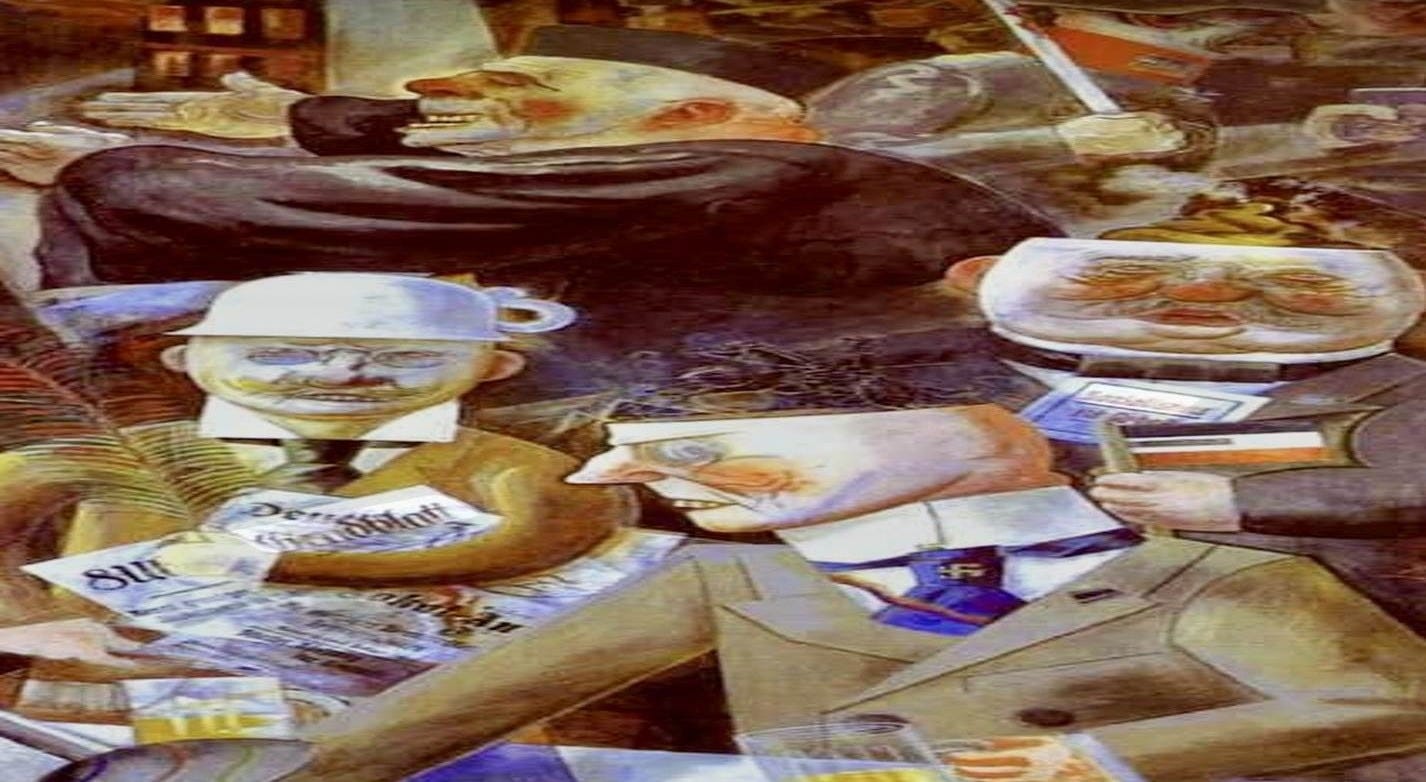
THE ABDICATION
How American Institutions Learned to Be Afraid
In Minnesota, the thaw arrives late this year, and what it gives up is already ruined.
When the snow recedes from the boulevards in the last days of April, the ground discloses what winter preserved: a child’s mitten, stiff with road salt; a January newspaper pulped past reading; the hand tools someone left in the yard last fall, rusted now beyond any honest use. Their own weather had protected them. Then the light came back and made their condition visible. By then, it was too late to repair them.
I have come to think of this as much a civic season as a meteorological one. Every spring, the thaw exposes what was deferred. What went unsaid. What was permitted to remain unresolved because, in the cold, it was easier to let it lie. And every spring, some of what was deferred turns out to have been destroyed by the deferring.
This is the condition of American institutional life in 2026. We are seeing, in the late light, what has been happening under the cover of winter. The hollowing of agencies. The capture of regulatory capacity. The gutting of research infrastructure. The slow dismantling of the machinery by which a democracy maintains itself, not by spectacle but by habit. Most of it became visible only after it was already advanced. The thaw arrived, and the tools were already rusted.
What is being revealed is not corruption. Corruption is the diagnosis we reach for when we want to feel angry without feeling implicated. It puts the failure outside us, in a few venal actors and captured agencies, and promises that scrubbing the rot would restore the house. But the institutions I am describing are not rotten. They are frightened. They have spent three decades redesigning themselves to be intact rather than right, and when the test came, they were intact. They were also useless.
The word for this is cowardice. I mean it in its old sense: the absence of the willingness to act on what you know.
Every generation invents its own moral alibis. Ours prefers the language of neutrality. When institutions decline to say what they believe, they call it complexity. When they refuse to judge, they call it inclusiveness. When they retreat from clarity, they call it the common good. None of this is wisdom. It is abdication, carefully managed and publicly applauded, and it has costs the abdicators have not been required to pay.
Neutrality used to be a posture. It has become the operating system.
The Two Traditions
I came to Minnesota from somewhere else. I was educated by it. That gives me a particular stake in what I am about to say, which is that this state holds a civic memory that makes the present abdication feel like a specific kind of betrayal.
In the summer of 1948, on the floor of the Democratic convention in Philadelphia, Hubert Humphrey told his party to walk out of the shadow of states’ rights and into the bright sunshine of human rights. He knew what it would cost. The Dixiecrats walked. Strom Thurmond ran. The party split. Humphrey went on to help write the Civil Rights Act sixteen years later, and the party that had taken the risk won three of the next five presidential elections. The cost of clarity was real. The cost was survivable.
Paul Wellstone said we all do better when we all do better, and the line was not a slogan. It was a wager on a politics that treated conflict as the condition of solidarity rather than its enemy. The Farmer-Labor tradition that built this state was assembled by people who understood that cooperation does not mean the absence of an argument. It means an agreement on what is worth fighting about and then having the stomach to fight.
That inheritance has been quietly displaced by another one. Minnesota Nice: the careful kindness that refuses to say the hard thing, the studied blandness that mistakes avoidance for grace. We have always had both traditions. What has changed is that the institutions built on the first have been steadily captured by the second. The cooperative becomes the compliance workshop. The union hall becomes the HR retreat. The civic editorial becomes the comprehensive statement that says nothing at all. The shape persists. The nerve is gone.
What the Institutions Will Not Say
To call this a crisis of cowardice is to risk the abstraction that haunts so much recent writing on American decline. The complaint flatters the complainer. Everything is failing, everyone is afraid, and nothing can be said. So let me name some specifics.
In the months after October 7, 2023, elite American universities produced statements so carefully constructed that they committed to nothing at all. Asked under oath whether calls for the genocide of Jewish students violated their own codes of conduct, three university presidents — Harvard, Penn, MIT — could not bring themselves to answer plainly. It depends on the context, they said. Two of them lost their jobs not for what they believed but for what they could not bring themselves to say. The institutions they led had trained them out of the habit of moral speech. Students on every side of the conflict correctly perceived that the universities educating them lacked the nerve to distinguish protected speech from targeted threat, protest from harassment, complexity from surrender. The result was not neutrality. It was illegibility, the particular modern condition in which institutions cannot tell you what they believe because they no longer know.
The defenders of institutional silence will invoke the Kalven Report, the 1967 University of Chicago document that counseled universities to refrain from official positions on contested public questions. Kalven was right about something specific: a university should not have a foreign policy. But the doctrine has metastasized far past its original use. What was meant to protect the conditions of free inquiry has been recruited to excuse the absence of moral nerve. Kalven did not tell university presidents that they could not name a threat to the safety of their own students. They have told themselves that, because it has become easier than the alternative.
Major American newspapers now describe demonstrable falsehoods as disputed claims or statements without evidence. This is not accuracy. It is the outsourcing of accuracy to the reader. The paper knows the claim is false. The paper could say so. The paper has chosen instead to print the falsehood and let it stand alongside its correction as if the two were equivalent entries in the public record. The logic is institutional self-protection. If we call a lie a lie, we will be accused of bias; if we are accused of bias, our advertisers and subscribers will flinch; therefore, we will use a softer word. The reader learns, correctly, that the paper will not tell them what it knows.
Consider corporations. The public commitments of the summer of 2020 have been quietly withdrawn. Diversity programs have been restructured into risk postures. Pride collections have become Pride reductions. Target, headquartered only a few miles from where I write this, announced in January of 2025 that it was ending the programs it had spent three years defending. The programs were not failing. They had become expensive to defend. The boycotts had arrived. The legal environment had shifted. The lawyers had done the math. This is not a story about the wickedness of corporations. Corporations are not moral agents and never have been. The story is about us. We asked a company that sells home goods to tell us what to believe about justice, and we are surprised when the company tells us instead what sells. We asked the wrong institutions to be the conscience of the country. We should not be stunned when they decline the job.
The Risk Manager’s Gospel
None of this is a conspiracy. It is the predictable result of a system in which moral reasoning has been replaced by risk management. Legal exposure, reputational harm, donor pressure, social-media backlash: these forces discipline behavior more effectively than any ethical framework, because they carry an immediate price tag. Caution hardens into reflex. The goal stops being to be right. It becomes unassailable.
The governing figures of American institutional life are now the in-house counsel, the communications consultant, the crisis-management firm, and the risk officer. The trustee, the editor, the president, the elected board — the people whose job it once was to say what the institution believed — have become figureheads who sign the statements the lawyers draft. They are very good at their work. Their work is not to help the institution say what it believes. Their work is to help the institution survive, having beliefs at all.
This took a generation to build. We confused conflict with harm and disagreement with injustice. We trained ourselves, individually and institutionally, to believe that clear winners and losers were evidence of failure, that judgment itself was exclusionary, that moral lines were inherently suspect. What began as an effort to be humane ended as an aversion to responsibility. We built whole vocabularies to describe moral problems without committing to solving them. Stakeholders. Lived experience. Harm reduction. Impact. Each began as a useful distinction and ended as a way to talk about a difficult thing without doing anything about it.
The right has not done better. Its response to institutional cowardice is moral pantomime — certainty without inquiry, judgment without standards, a performance of conviction that mistakes volume for authority. The flood-the-zone strategy is its own form of cowardice: the refusal to acknowledge that some claims are false, that some arguments fail, that some positions cannot survive contact with evidence. One side abdicates by saying nothing. The other abdicates by saying everything so loudly that nothing can be heard. Both surrender the ground that made the democratic argument possible.
I am aware that some readers will find one of these failures more sympathetic than the other. They are unequal in many ways: in scale, in malice, in proximate damage. They are equal in this: each is a refusal to be in the same conversation with people who disagree.
The Cost
A society that refuses to name loss, failure, and wrongdoing does not become more just. It becomes more brittle. When every disagreement is treated as an injury, institutions lose the capacity to distinguish discomfort from injustice and collapse both into silence. When institutions refuse to judge, citizens learn that judgment itself is illegitimate, and they go to the fringes to find it.
Trust does not erode because people demand perfection. It erodes because people recognize an evasion when they see one. When leaders decline to exercise moral authority, the vacuum is filled by whoever is least hesitant to speak. Not the wisest. Not the most accurate. The loudest. The angriest. The most certain.
Cowardice at the top radicalizes the bottom.
We are living inside the consequences. The collapse of institutional credibility did not produce a more humble citizenry. It produced a citizenry that trusts no institution and believes whatever confirms its fear. The least responsible voices have become the most authoritative, because the responsible ones would not speak.
What Judgment Requires
There is no program for the recovery of institutional courage. Courage is not a policy. Dispositions are not legislated into being. But they can be modeled, practiced, and restored. And the beginning of any restoration is the recognition that the habits we have lost are not ancient. They are recent. Their absence is contingent. What was done can be undone. A few things are worth saying plainly.
The cost of judgment has been overestimated for a generation. This is the central lie that institutional cowardice tells itself: “if we say what we know, we will not survive.” History is reliably uncooperative with this claim. Humphrey’s party split in 1948 and won three of the next five elections. The Supreme Court ruled in Brown v. Board, and the Republic persisted. Walter Cronkite went on television in 1968 and said the Vietnam War was unwinnable, and CBS News did not collapse. The Washington Post pursued Watergate, and its readership tripled. The institutions that have collapsed in the last half-century did not collapse because they spoke clearly. They collapsed because they stopped being useful, because they stopped doing the thing they were built to do. The risk managers have been selling a false choice for thirty years. The alternative to courage is not survival. It is irrelevance with good legal advice.
Authority inside institutions has to be moved back to the people who were supposed to wield it. Boards can write their own statements. Editors can overrule their publishers. Presidents can speak without clearance. The structural reform here is modest: return moral speech to the people whose job it was, and accept that the lawyers will be unhappy. Institutions are supposed to make the lawyers unhappy sometimes. That is what institutions are for.
Scale matters. The most vital institutions in American civic life right now are not the largest ones. They are the small presses that publish what the big ones will not. The community papers that still name names. The neighborhood associations that still argue at public meetings. The co-ops and credit unions are built on the principle that some decisions are too important to outsource to markets. The congregations that still preach a discomforting sermon. These institutions are not invulnerable to the forces I have been describing. But they have been less captured by them, because they are close enough to their members that cowardice is visible and paid for in real relationships. The recovery probably begins here, not in the reform of the captured institutions but in the reinforcement of the ones still working. In Minnesota, that means taking the cooperative tradition seriously as a living form of governance and not a museum exhibit. The credit union, the co-op grocery, the rural electric, the community land trust: these are not quaint. They are the American institutional forms that have been least vulnerable to the risk-management takeover, and they have not been studied carefully enough as models for what larger institutions might become again.
The hardest thing to say is also the most necessary. Institutions are not abstractions. They are made of people. The university that cannot speak is made of professors and administrators who did not insist that it speak. The newspaper that will not name a lie is made of reporters and editors who filed the copy and approved the headline. The corporation that withdrew its statement is made up of executives and board members who voted for the withdrawal. Institutional cowardice is individual cowardice, aggregated and laundered through process. Every person inside a captured institution has more agency than they pretend. Most will not use it. Some will. History is reliably clear about which we remember and which we forget. The recovery begins with the ones who act, not in the expectation that the institution will back them, because it will not in time, but in an older understanding that the institution is not something that acts upon you. It is something you are.
The Shovel and the Work
It is no coincidence that we find ourselves here at the start of May. To the world, May Day is a celebration of labor. To the sailor in distress, Mayday is the final cry for help before the hull gives way. Our institutions are broadcasting both at once.
In Minnesota, we used to understand this. Not because we were more virtuous, but because our civic culture was built by people — Scandinavians, Somalis, Hmong refugees, labor organizers, teachers, farmers — who arrived from places where institutional cowardice had body counts. They built the independent paper, the neighborhood association, the land-grant university, the cooperative, and the credit union because they knew that institutions were not decorative. Institutions were how a community decided what it would and would not tolerate. They understood that the price of institutional courage was modest compared with the price of its absence.
The shovel in the garage is not just for the driveway. It is the daily, physical acknowledgment that some things require labor and some labor cannot be deferred. You do not negotiate with the snow. You do not issue a carefully worded statement to the ice. You go outside, you do the work, and your neighbor sees you do it, and you see your neighbor do it, and something is confirmed between you that does not need a press release to be real.
Every spring, the thaw reveals what we deferred. This year, the thaw has come late, and what it is uncovering is already past saving — the tools too rusted to swing, the papers too pulped to read, the mittens that will not fit the hands that have grown. The instruments of our democracy — the ability to reason, to judge, to stand ground, to say the true thing at the cost of being disliked — oxidize quickly when they are not used. Our institutions are not going to save themselves. The people inside them will either recover the habit of judgment, at whatever cost, or they will watch it pass into hands that have no scruple about wielding it crudely and no memory of what it was for.
A civilization does not collapse because it argues. It collapses when it decides that judgment is too dangerous to risk. More precisely, it collapses when the people who were supposed to do the judging conclude it was someone else’s job, and the someone else turns out to have different ideas about what the judgment was for.
The thaw has come. The shovel is where you left it.
© 2026 Charles J. DiVencenzo Jr. All rights reserved.