
The Desert Is Clean
T. E. Lawrence and the Limits of Understanding

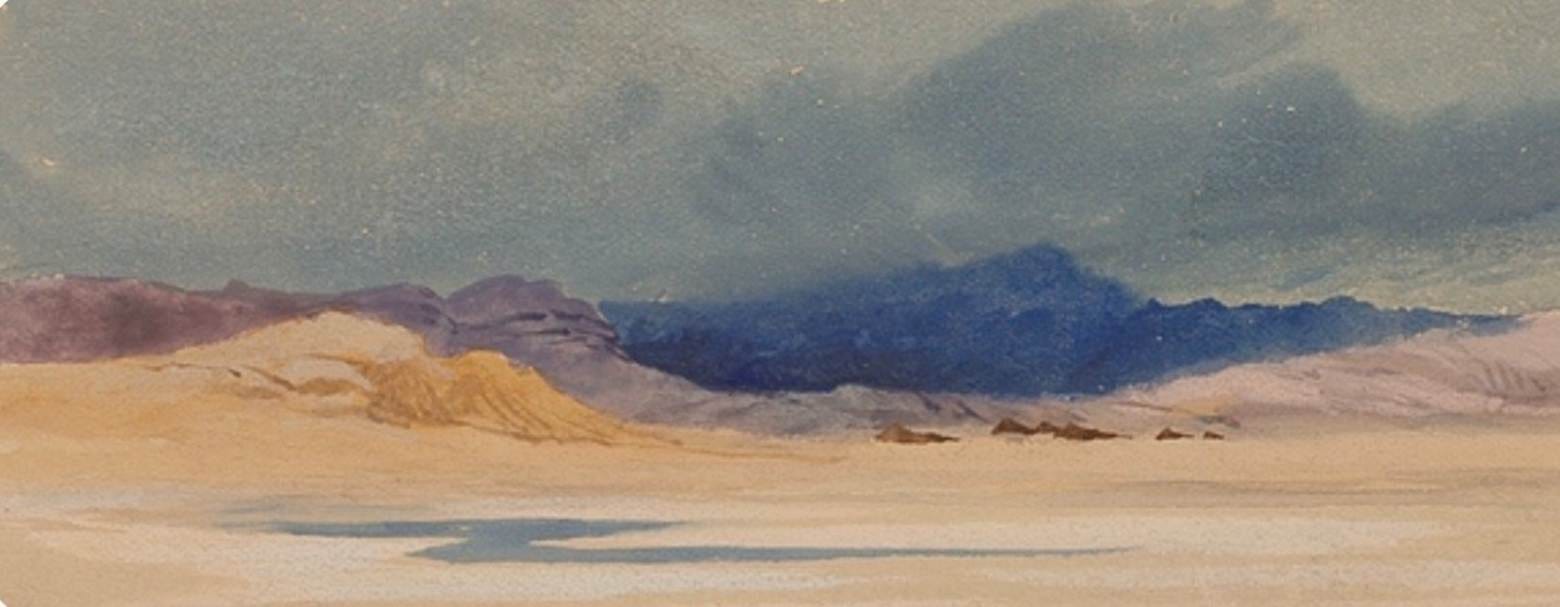
Lilias Trotter, Desert Stream, (Watercolor)
The Desert Is Clean
T. E. Lawrence and the Limits of Understanding
By Charles J. DiVencenzo Jr. August 16, 2026
“It’s clean.”
In Lawrence of Arabia, David Lean’s magnificent 1962 film about T. E. Lawrence and the Arab Revolt, a journalist asks what attracts Lawrence to the desert. That is his answer: two words, delivered almost casually.
I’ve always loved that line. The older I get, the less I believe it.
The desert may look clean from a distance: sand, sky, horizon. Almost nothing to interrupt the eye, no clutter, no obvious place to hide. Human beings are another matter.
So was Thomas Edward Lawrence, born on this day in 1888. He has been called many things: archaeologist, soldier, scholar, intelligence officer, Arabist, adventurer, imperialist, liberator, egotist, fraud, hero. The problem is that nearly all of them contain some truth. Perhaps that is why we are still arguing about him.
Lawrence went into the Middle East with something many British officers of his generation lacked: genuine curiosity. Before the First World War he had traveled through the region, studied its archaeology, learned Arabic, and absorbed its history, developing a rare familiarity with the people among whom he would later fight. He looked closely. But looking closely and seeing clearly are not necessarily the same thing.
During the Arab Revolt against the Ottoman Empire, Lawrence became closely associated with Prince Faisal. Faisal was no background figure in a British hero narrative; he was a sophisticated leader of the ancient Hashemite dynasty, pursuing his own complex vision of Arab sovereignty. Lawrence rode with Arab forces, fought beside them, and increasingly identified with their aspirations. At the same time, he remained a British officer serving an empire with ambitions of its own. That contradiction became impossible to escape.
Britain encouraged Hashemite hopes for independence while it and France were privately negotiating how much of the Ottoman Middle East they might divide between themselves. With a few strokes of a pen, European cartographers drew arbitrary lines across the sand, inventing modern borders for Iraq, Syria, and Palestine without the slightest regard for the tribal, religious, and cultural realities of the people who lived there. They used Faisal’s family to win a war, then scattered them across newly manufactured thrones, installing Faisal in Iraq and his brother Abdullah in Jordan, while leaving the Arabian Peninsula to be reshaped by the House of Saud.
Lawrence knew enough to understand the betrayal taking shape around him. He continued anyway.
That may be the most interesting thing about him. Not that he was a hero, not that he was a hypocrite, but that he was a human being caught between what he believed, what he represented, and what he was willing, or able, to do about the distance between them.
We prefer cleaner categories: hero or villain, colonizer or liberator, loyal or treacherous, victim or perpetrator, right or wrong. The desert offers a horizon. Human beings offer contradictions.
Lawrence himself complicated matters by becoming an author of his own legend. In Seven Pillars of Wisdom, memory, history, confession, and self-creation sit uneasily beside one another. Later generations added more layers: Lowell Thomas helped turn Lawrence into an international celebrity, and David Lean and Peter O’Toole transformed him again into one of cinema’s most unforgettable figures. By the time most of us encounter T. E. Lawrence, we are several Lawrences removed from the man himself.
Perhaps that is appropriate, because recognition is harder than it looks.
I’ve been thinking a great deal lately about curiosity and recognition, not merely as qualities of intimate relationships, but as disciplines for moving through the world. Curiosity says: I want to know you. Recognition asks something harder: Am I willing to let what I discover change the story I have already told myself about you?
Lawrence possessed that curiosity. So did the British Empire, in its way.
Empires map, they catalogue, they translate; they study languages, customs, religions, tribal affiliations, trade routes, and political rivalries. The British became extraordinarily skilled at understanding other people’s civilizations. They were considerably less skilled at resisting the temptation to run them.
There is the distinction: curiosity without humility can become another form of possession. You can know an extraordinary amount about another people and still assume you know what is best for them. You can learn someone’s history without recognizing their autonomy. You can listen carefully while waiting for the opportunity to explain them back to themselves.
The wreckage of that imperial arrogance is not the only reason the region struggles today; history is rarely that clean. But it remains one of the significant ones, and we are still living with it.
And if we are honest, we do the same thing to one another in our daily lives. We meet someone and immediately begin assembling a theory. Their politics tell us who they are. Their profession tells us who they are. Their marriage, their divorce, their religion, neighborhood, diagnosis, mistake, silence, social-media feed, or one terrible decision becomes sufficient evidence for a verdict.
Eventually we stop encountering the person; we encounter our explanation of them. That is not recognition. It is classification.
Lawrence understood more about Arabia than almost any British officer around him. Yet even he could not escape the assumptions of the world that produced him, or the temptation to imagine that his unusual understanding gave him an outsized right to shape events. That isn’t merely an imperial problem. It’s a human one. Understanding another person does not confer ownership over their future.
Perhaps real recognition begins precisely where our theories fail.
David Lean understood something about this. His film gives us nearly four hours of Lawrence and leaves him, somehow, more mysterious at the end than at the beginning. The spectacle is enormous: the mirage, Aqaba, the trains, the white robes against the sand. But the man at its center becomes progressively harder to see. The closer we get, the less clean the picture becomes.
That may be why the desert matters so much. From a distance it appears empty. Walk into it, and distinctions emerge: stone, wind, heat, shadow, tracks, danger, life. People are like that. From far enough away, everyone becomes easy to explain. Get close, and the categories begin to fail.
Maybe wisdom isn’t finally arriving at the correct explanation of another human being. Maybe it is retaining enough curiosity to understand that our explanation will always be incomplete. That requires something more difficult than knowledge.
Humility.
Lawrence spent much of his later life trying to escape the celebrity that had formed around him. The man who became “Lawrence of Arabia” seemed increasingly uncomfortable being Lawrence of Arabia. Perhaps he understood the problem better than anyone. Once the world decides who you are, it can become nearly impossible to persuade it to look again. We should remember that before doing the same thing to one another.
“It’s clean.”
Maybe Lawrence was right after all, not because the desert is simple, but because it strips away the illusion that simplicity was ever there. No walls, no convenient shadows, no comfortable clutter behind which to conceal ourselves. Only distance, horizon, and whatever we carried into it.
Lawrence carried an empire. He carried Arab hopes. He carried ambition, sympathy, vanity, courage, contradiction, and eventually a legend larger than the man himself. None of it was clean.
Neither are we.
Recognition may begin when we stop demanding that other people be.
The desert does not tell us who we are. It simply removes enough clutter that, eventually, we may have to look. And then, if we’re curious enough, look again.
© 2026 Charles J. DiVencenzo Jr. All rights reserved.