
The Long Appeal
On the Education That Begins After Certainty

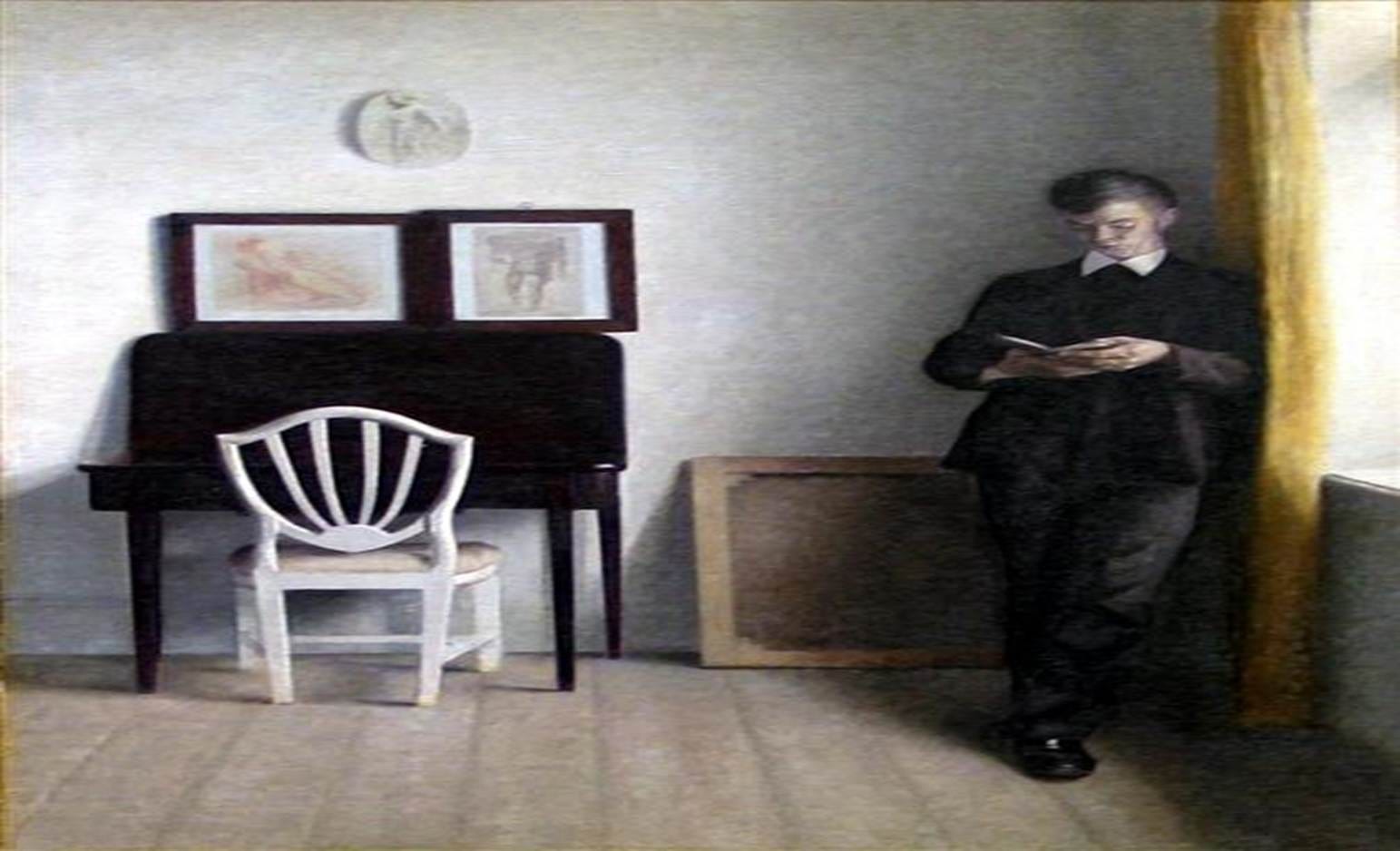
Interior with Young Man Reading (1898) by Vilhelm Hammershøi
The Long Appeal
By Charles J. DiVencenzo Jr. August 12, 2026
Somewhere along the way, and I suspect it happens at a different age for each of us, the questions begin to matter more than the answers.
That isn’t how most of us are taught to live. We spend our younger years collecting answers because answers are what schools reward, careers reward, and, for a while anyway, the world itself appears to reward. Learn enough. Work hard enough. Be confident enough. Reach the next milestone and move on to the next one.
For a long time I believed that was the purpose of education.
It has taken me more than forty years to realize that the most important education begins only after we think we’ve graduated; not from school, but from certainty.
Looking back, I don’t think age has made me wiser so much as it has made me more curious. At twenty-three, I wanted to know who was right. At sixty-five, I find myself wondering how people arrived where they did. Those are very different questions. One seeks a verdict. The other seeks a life.
We live in a culture increasingly consumed by accumulation—wealth, opinions, followers, victories—while quietly neglecting the philosophical work that makes a civilization worth inhabiting. We confuse the possession of information with wisdom, when the two are often only distant relatives.
Knowledge, by itself, can become surprisingly static. It builds walls, defends positions, and grows comfortable with certainty. Curiosity does something else entirely. It opens doors. It invites another chair to the table. It asks one more question after everyone else has decided the conversation is over.
Finding someone whose intellect is matched by that kind of enduring curiosity is rare. When it happens, the conversation doesn’t really end. It continues long after the people have gone home.
I didn’t understand any of this when I entered law school at twenty-three.
Like most first-year students, I thought the law was principally about justice. Instead, I found myself immersed in civil procedure; rules governing how disputes arrive where they do, who gets heard, when they get heard, and sometimes, painfully, when they don’t.
At the time it seemed technical, almost mechanical. Years later I began to see something else. Those rules were really an attempt to answer an ancient human question: How do strangers live together without settling every disagreement by force?
That isn’t simply a legal question. It’s the question behind every functioning society.
Every civilization rests upon agreements that have no physical existence of their own. A dollar bill has value because enough of us continue to believe it does. Bitcoin, for all its novelty, rests on much the same foundation: confidence. Contracts, corporations, citizenship, universities, marriages, elections—even the simple expectation that another driver will stop at a red light—all depend upon millions of people honoring invisible understandings every day.
We sometimes dismiss these as social constructs, as though that makes them less real.
The opposite is true.
The things we imagine together often become the most consequential realities we ever experience. They shape our opportunities, define our obligations, protect us, disappoint us, and occasionally fail us altogether.
The older I become, the less interested I am in deciding whether our institutions are perfect. They never have been. What interests me now is why they endure for generations, why they sometimes weaken, and what happens to ordinary people when confidence in them begins to erode.
Perhaps that’s why, every few years, I find myself back at twenty-three. Not in memory. In a dream.
I’m standing outside my first law school classroom when one of my professors intercepts me with a case. Sharp in his Brooks Brothers suit, rep tie, and horn-rim glasses, he speaks with that unyielding authority.
“Tell me how it got here.”
I begin explaining. After every answer comes the same question.
“Why?”
Jurisdiction.
“Why?”
Venue.
“Why?”
Standing.
“Why?”
The questions continue until I wake, never having reached the end.
For years I assumed the dream was about law school. Now I think the professor was teaching something much larger than civil procedure.
Humility.
The understanding that beneath every conclusion lies another question, beneath every public controversy lies a private story, and beneath every judgment lies a life no outsider can ever fully reconstruct.
Years later, when I found myself teaching leadership and marketing at Skidmore, I caught myself asking my own students that same Socratic question. I wasn’t looking for polished answers nearly as much as I was looking for the next honest “why.” Leadership, I gradually came to believe, begins at the moment we stop performing certainty and become genuinely interested in understanding.
I’ve come to believe that every person carries an invisible procedure; a sequence of disappointments, unexpected kindnesses, losses, small betrayals, and a few accidents of luck that eventually bring them to the place where we meet them.
We encounter the conclusion. We seldom witness the argument that produced it.
Perhaps that is the second education. Not learning to argue more effectively, but learning to understand more generously.
The years ahead no longer ask me to accumulate more accomplishments than the years behind me. They ask something quieter. To become a little less certain. A little more curious. A little slower to judge. A little more willing to believe that every person I meet is living inside a story I cannot fully see.
The coffee is ready now. Outside my window, Minneapolis is settling into another ordinary morning.
The professor has disappeared again, and with him the dream. I still don’t know how the case got there.
After all these years, I’ve come to believe that was never the real question. The real question was whether a lifetime could teach me to look at another person; and at the fragile agreements that hold us together, see the arguments behind the verdict, and the long, unseen procedure that brought them there.
© 2026 Charles J. DiVencenzo Jr. All rights reserved.
What a beautiful essay. Thank you.
So beautiful. Thank you Chuck.