
THE REPUBLIC OF AVOIDANCE
How the Psychology of Fear Became the Culture of America

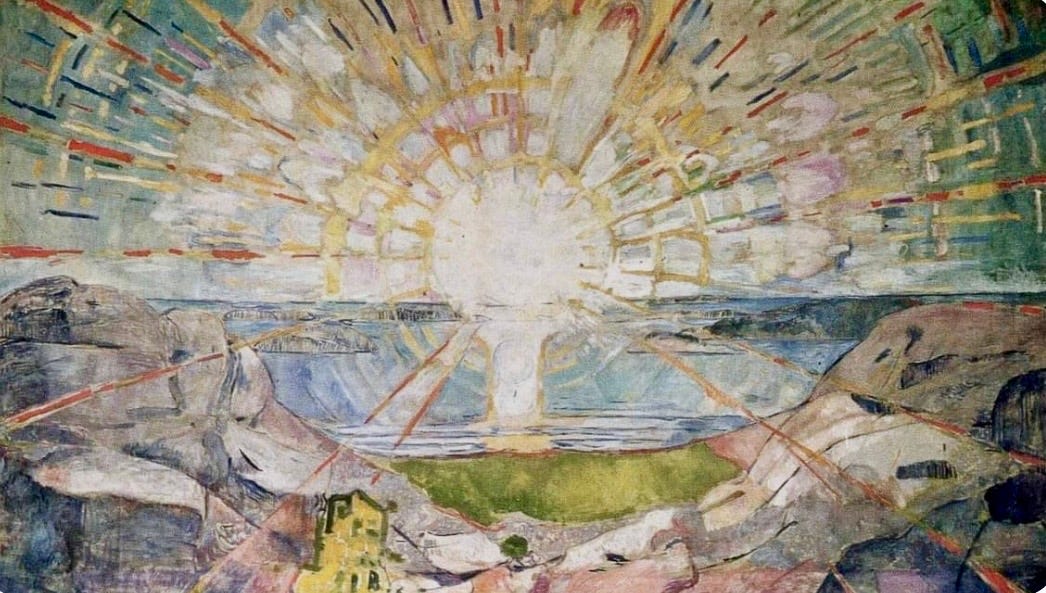
Edvard Munch, The Sun, 1911, University of Oslo, Aula
THE REPUBLIC OF AVOIDANCE
How the Psychology of Fear Became the Culture of America
By Charles J. DiVencenzo Jr. August 10, 2026
Just after sunrise, a handful of volunteers gather around pushed-together tables at a neighborhood café in St. Louis Park. Coffee cups steam. Notebooks open. Someone reviews committee assignments. Another talks about a trip to the State Capitol. They compare calendars, discuss testimony, and decide who will meet with legislators the following week.
They’re retired teachers, engineers, attorneys, parents, and grandparents; many of them are affiliated with the League of Women Voters.
Committees focus on election administration, civic education, environmental stewardship, housing, and local government. Some weeks, they’re joined in the café by parents whose lives have been permanently altered by unimaginable loss. They don’t come looking for sympathy. They come because they believe their experience might help spare another family the same grief. The League volunteers don’t speak for them; they help make sure they’re heard.
No one at those tables knows whether a conversation will change a vote, whether a committee meeting will influence a bill, or whether a legislator will remember a story six months from now.
They show up anyway.
I’ve known people like this throughout my life. They believe democracy isn’t something we inherit every four years. It’s something we practice every week: in committee meetings, church basements, libraries, neighborhood cafés, school cafeterias, and conversations with people who don’t always agree with us.
Watching them, I began to suspect that what keeps those tables full is the same thing that sustains every meaningful human relationship: participation.
Yet over the last generation, we’ve learned to describe our lives through a different lens: the language of psychology. We talk about trauma, boundaries, self-care, attachment, and anxiety.
Modern psychology has given us a richer vocabulary for understanding ourselves. It describes several broad attachment styles—secure, anxious, avoidant, and disorganized—not as labels, but as patterns in how people navigate trust, vulnerability, and intimacy. Those ideas have helped millions approach their relationships with greater compassion.
But I wonder if we’ve overlooked something. What if patterns no longer describe only individuals? What if they now describe the culture we’ve built together?
Look around. We ghost instead of explaining, text instead of calling, let difficult conversations quietly disappear rather than have them. We retreat into algorithms that reassure us instead of neighbors who might challenge us, and sort ourselves into political tribes where certainty is rewarded, and curiosity often feels like weakness.
Every decision is understandable on its own. Taken together, they become culture.
We often describe America’s problems one at a time: loneliness, political polarization, declining trust, fewer close friendships, weakening civic organizations, and lower participation. What if they are all expressions of the same instinct? Not hatred; avoidance.
Avoidance rarely arrives dramatically. It arrives politely, an invitation left unsent, an apology postponed, a meeting skipped, an election ignored.
None of these moments seems especially important on its own. Until, years later, we wonder why our friendships feel thinner, our institutions weaker, and our democracy more fragile.
For much of my career, I worked with institutions in law and financial services, including legislatures, associations, nonprofits, regulators, and advocates. I’ve watched organizations succeed and fail, campaigns rise and disappear, movements gather momentum and lose it. The difference is seldom that one side possessed all the right ideas. It’s that one side kept showing up after the excitement faded.
Institutions don’t create engaged citizens. They are created by engaged citizens.
Every durable institution I’ve known has depended on ordinary people willing to attend one more meeting, make one more phone call, or spend an afternoon doing work that will never make the front page. That’s what participation looks like.
The volunteers working a local primary don’t know who will win, whether the people they register share their politics, or whether their efforts will change a single outcome.
They do the work anyway.
Perhaps that’s what psychologists would recognize as security, not certainty, not confidence, but trust: the quiet belief that participation itself has value.
I’ve spent enough years watching people to know something else: relationships survive much the same way, not because they avoid disappointment, but because someone keeps participating—makes the phone call, writes the note, apologizes, forgives, remains curious after certainty would have been easier.
The strongest marriages I’ve known aren’t the ones that escaped disappointment. They’re the ones where two imperfect people kept choosing one another after disappointment arrived. Friendship works the same way. So does citizenship.
I’ve come to believe that recognition is one of the highest forms of love, not romance alone, but the willingness to believe another human being is always more than the conclusion we’ve already reached about them. Curiosity is its companion. Curiosity refuses to let certainty have the final word. Both ask something difficult of us: participation.
Growing older, I think, was never going to be about becoming fearless. Fear has always accompanied every worthwhile decision. The real question is whether we let it organize our lives.
Before summer gives way to autumn, register to vote. Volunteer. Say yes to the coffee. Invite someone for ice cream. Write the letter. Make the phone call. Tell someone they mattered. Accept the apology. Offer one if it’s yours to give.
Most of all, stay curious. Keep showing up.
Avoidance promises safety. Participation offers meaning.
Democracies don’t survive on agreement. Neither do marriages, friendships, or families. They survive because ordinary people continue to participate even after certainty has disappeared.
The opposite of avoidance isn’t certainty. It’s participation.
The future has never belonged to people who waited until they knew how the story would end. It has always belonged to those willing to keep showing up.
© 2026 Charles J. DiVencenzo Jr. All rights reserved.
Participation and curiosity—love this!