
The Years We Misjudge
On Herman Melville’s Birthday

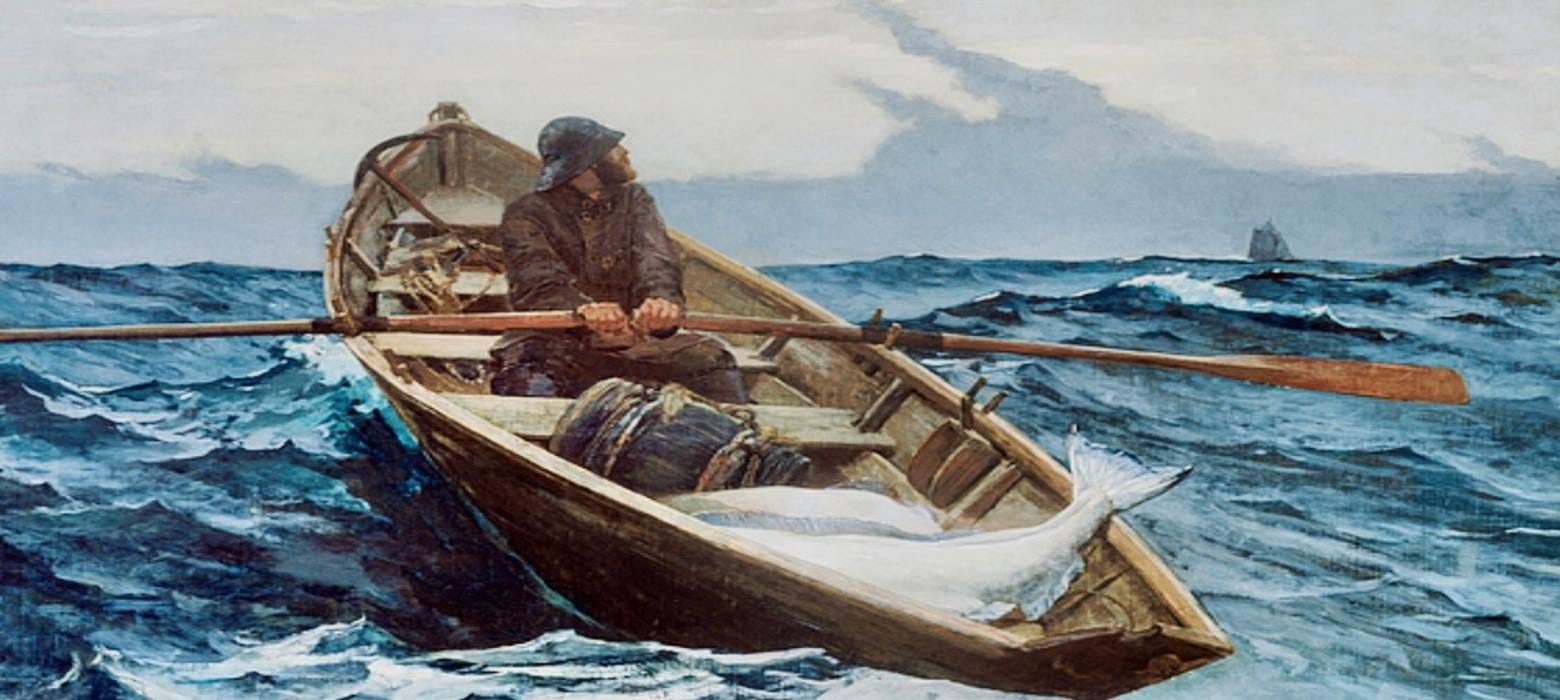
Winslow Homer, The Fog Warning, 1885, Museum of Fine Arts, Boston
The Years We Misjudge
On Herman Melville’s Birthday
By Charles J. DiVencenzo Jr. August 1, 2026
Now and then I find myself thinking about Herman Melville. Not because I reread Moby-Dick every summer, but because, years ago, I occasionally walked past his house without realizing that one day it would matter.
My office in Albany sat on Elk Street, only a short walk from the modest brick home where Melville once lived. I wasn’t there every day; my work carried me between Albany, Manhattan, and cities across the country. Lunch was often a quick meeting or an airport gate. But on quieter lunchtimes I’d head out for a sandwich and unknowingly pass the home of a man who understood something I had not yet learned.
At the time, I was in my forties. Like most people in their forties, I believed I was building a life, not remembering one.
My family lived thirty miles north in Saratoga Springs. We built a home on a hillside where the backyard disappeared into woods. It was the sort of place that encourages permanence. You plant trees. You choose paint colors carefully. You imagine grandchildren someday running through the same backyard.
You don’t build a house thinking you’re building six years. You build it believing you’re building forever.
Most weeks followed a familiar rhythm: Albany, Manhattan, airports, conference rooms, and then the race north. Not because another meeting awaited, but because football practice started at six. I had promised my son I’d coach.
There is something wonderfully clarifying about coaching eleven-year-olds. They don’t care about your title. They don’t know your strategic plan. They only know whether you showed up.
Football teaches lessons adults are forever trying to relearn. You get knocked down. You get up. You trust the teammate beside you. You discover that courage, up close, is mostly just the decision to run the next play. I thought I was teaching those boys. Looking back, they were quietly teaching me.
There was a classroom in the more literal sense, too. One night a week I taught a course at Skidmore—leadership, a little marketing, the kind of business sense that never fits cleanly on a syllabus. The students were upperclassmen, a year or two from lives they were certain they’d already mapped, and mostly they reminded me how much nerve it takes to stand at the start of something and not yet know how it turns out. Being on the faculty came with a quieter privilege: access to speakers, special programs, and the distinguished alumni returning to discuss their notable accomplishments. So, I’d sometimes bring my son and daughter to these functions, the kind that pull people on campuses—and let them sit among ideas pitched years above their heads. They took a taste of it, the way children do, sideways and without knowing it. I liked watching them move through a world that wasn’t yet built for them.
Summers belonged to my daughter. She had a gift for friendship. On warm afternoons our backyard filled with girls carrying towels, goggles, and enough energy to make the entire hillside seem alive. I’d stand over the grill cooking hot dogs while a tray of homemade chocolate chip cookies cooled inside the kitchen. They disappeared almost as fast as I could make them.
Twenty years later, some of those girls still remember those afternoons. They don’t remember what I did for a living; they remember the hot dogs, the cookies, and the feeling of being welcomed. Children are often better historians than adults. Adults remember promotions; children remember how a house felt.
Late at night, after everyone had gone to bed, I’d sometimes slip back into the saltwater pool alone. The water still carried the day’s warmth. Beyond the edge of the pool there were no lights, only woods fading into darkness and a sky crowded with stars. It was quiet enough to hear questions that daylight politely postpones.
Looking back, I realize that house carried its own contradiction. It was beautiful in every way we had hoped. The woods gave us privacy. The stars gave us silence. But beauty and isolation sometimes occupy the same address. We imagine a house, a promotion, or a new city will settle the questions we carry. Places can shelter us. They cannot answer them.
By then, work had become more demanding than I imagined. Marriage had grown far more complex than either of us anticipated. A few years later, the financial crisis would remind millions of Americans that certainty is often little more than confidence stretched over events we do not control.
That isn’t tragedy. It’s adulthood.
One of the great mistakes we make in middle age is believing disappointment is evidence that something has gone wrong. Sometimes disappointment is simply evidence that life is real. I sometimes wonder whether Melville discovered the same thing walking those streets.
We know the books he wrote; we rarely imagine the ordinary Tuesdays. We remember Moby-Dick because history has already rendered its verdict, but he couldn’t. He lived inside that uncertainty, writing without knowing whether anyone would ever care, and kept going anyway. Much of the admiration we now take for granted did not arrive until decades after his death. Like so many of us, he never lived to see the final verdict on the years he thought he understood. Long before the world recognized the whale, he gave us Bartleby, the quiet clerk who famously declared he would “prefer not to”—a haunting reminder of what happens when a spirit simply resigns and retreats from the world.
There is a little Captain Ahab in every ambitious person. We cling to futures that no longer exist. We mistake obsession for purpose, and determination for the refusal to let life teach us something new. Ahab wasn’t destroyed because he pursued something difficult. He was destroyed because he could no longer imagine becoming someone different from the man who began the voyage.
Football had the better lesson. When you get knocked down, you don’t spend the next play arguing with the ground. You get up. You adjust. You trust your teammates. You run the next play.
Looking back now, I realize Albany and Saratoga were never simply places where I worked and raised children. They were classrooms.
I thought success meant building a career; it also meant building a home where children wanted to bring their friends. I thought achievement meant the next promotion; it also meant being on the sideline when I said I’d be there. I thought history was unfolding in boardrooms, but much of it was unfolding beside a grill, with hot dogs, chocolate chip cookies, and the loud, uncomplicated laughter of children who believed summer might last forever.
Today my children are in their twenties, making lives of their own. Their world is different from the one we imagined when we were raising them. They were among the first generation to grow up with smartphones and social media woven into childhood. Like every generation of parents, we embraced what looked like opportunity without fully seeing the costs that would come with it. Parenthood has always been an act of educated hope—we prepare our children for a future we cannot possibly predict.
Maybe that’s true of our own lives as well.
I no longer think about those years as the years when everything became complicated. I think of them as the years I misunderstood.
I believed I was building a résumé. I was building a memory.
I believed I was chasing success. I was becoming a father.
I believed disappointment was something to avoid. It turned out to be something to learn from.
I learned something else in those years, too. We measure our lives by years; memory measures them by depth.
That may be Herman Melville’s quiet gift; not the whale, not the voyage, not even the novel itself. Only the reminder that we never know, while we’re living them, which years are shaping us most. History always understands them later.
The greater danger is not disappointment itself. It is the invitation disappointment extends: to become smaller, to withdraw, to mistake caution for wisdom. Sometimes people retreat for a season. The trouble begins when the season quietly becomes a way of life.
When I think about Albany now, I don’t think first about the office on Elk Street or even the house around the corner where Herman Melville once lived.
I think about a football field. A tray of chocolate chip cookies. Hot dogs disappearing as quickly as I could put them on the table. A quiet pool beneath an August sky.
Those weren’t interruptions to my life.
They were my life.
© 2026 Charles J. DiVencenzo Jr. All rights reserved.