What Still Grows
On the Willingness to Start Anew

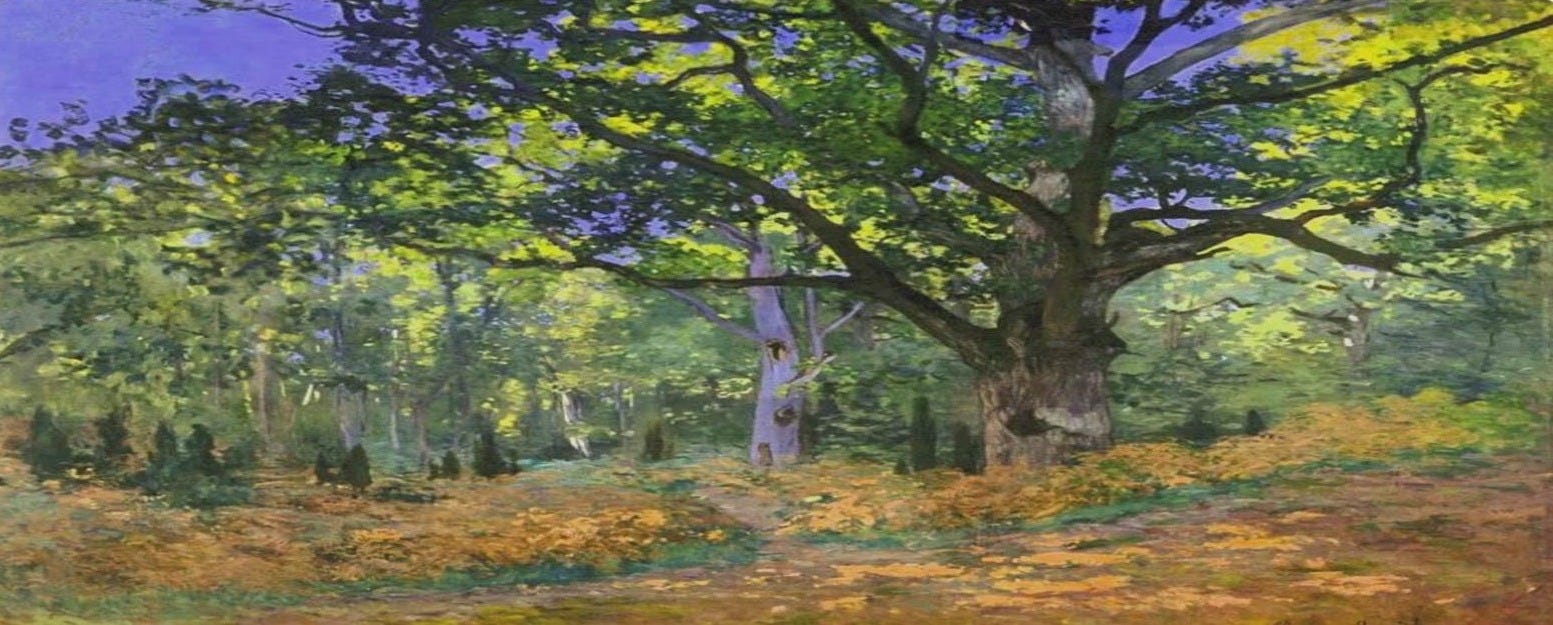
The Bodmer Oak, Fontainebleau Forest (1865), Claude Monet, The Metropolitan Museum of Art
What Still Grows
Part III of the Oak Trilogy
Charles J. DiVencenzo, Jr. August 5, 2026
It’s August, and the boxes are half-packed when the real sorting begins.
I leave Excelsior for a place near Lake of the Isles, and the weeks before a move turn out to be their own quiet inventory. Most of what I own is easy. The superfluous goes; the duplicate, the broken, the kept-for-no-reason. You’d be surprised how much of a life is just freight.
I should say plainly what this move actually is, because it isn’t really about downsizing. I’m not trying to own less for the sake of owning less — I still want the books, the painting, the desk with the one pen that writes right. What’s changing is proximity. Lake of the Isles instead of Excelsior. Walks I can take without getting in a car. Closer to downtown; the restaurants, the museums, the music you only stumble into when a city is a walk away instead of a drive. Closer to the curiosity I still have and don’t want to lose just because I’m getting older. Closer to the conversations, the energy, and the unpredictability that make a city feel alive.
That’s not minimalism. That’s just choosing, at this stage, to be near what’s still alive.
But then there are the other things. The painting that has hung on every wall I’ve owned. The saying tacked above the desk that I’ve read a thousand times and still need. The books I keep telling myself I’ll read again, knowing some of them I won’t. None of it is useful. None of it is certain. I carry it anyway, not because it guarantees anything, but because it still might mean something in a room I haven’t lived in yet.
We are intimidated by finished things. A sixty-year marriage. A great cathedral. An old oak standing against a hundred winters. We admire the structure and forget how ordinary the beginning must have looked. Every oak was once an acorn, small enough to lose in a coat pocket, planted by someone who never saw the shade it would throw.
Looking backward, it all appears inevitable. Looking forward, it never does.
Perhaps that’s why so many of us confuse caution with wisdom as we age. By our sixties we’ve buried people we loved, survived failures and illnesses and divorces, learned how much sheer effort it takes just to maintain a life. Somewhere in there we stop thinking in possibilities and start thinking only in outcomes. Will it work? Where does it go? How does it end?
The move teaches the lesson in the body, too. There was a time I’d throw a box on my shoulder without thinking; pure force, the certainty of a younger back. Now I bend at the knees. I make the second trip or leave the brunt of it to the movers. I lift smart instead of hard. The strength that once felt like certainty has become something slower and more deliberate, and, I’ll admit, wiser. Force was never the same thing as understanding.
A steady life doesn’t begin with a decade. It begins with a single day that doesn’t get counted until much later. Everything that lasts starts smaller than it will ever look again.
The older I get, the more skeptical I am of certainty, and the more I trust possibility. Certainty wants the ending. Possibility stays curious; and curiosity, I’ve come to believe, is one of the purest forms of faith we have. Not faith in outcomes. Faith that new things can still rise from old ground.
It’s why some people pass through our lives and become memories, while others keep a small, persistent place in our thoughts. That isn’t nostalgia. Nostalgia looks backward. What stays alive keeps asking the only question that matters: what might still be possible here?
The things we carry into the next place; the painting, the book, the person who never quite left our mind, aren’t problems to be solved. They’re reminders that unfinished is not the same as failed.
Maybe the most respectful thing one person can offer another isn’t certainty, or expectation, or demand. Only the quiet acknowledgment that some possibilities can survive a long winter.
There’s a spot near the new place, I’m told, where someone planted an oak decades ago; nothing remarkable yet, just a tree doing the slow, unglamorous work of getting taller. I don’t know who planted it. I’ll never know what they were thinking the day they pressed that acorn into the dirt and walked away without a single guarantee. But I know this: they didn’t do it for the tree it was. They did it for the tree it might become.
I’m not the acorn anymore. Whatever I was going to become, I’ve mostly become it. Most of the rings are there now, whether I count them or not. But a mature tree doesn’t stop being what it was meant to be. It still offers shade on hot afternoons. It still steadies the soil beneath it. It still drops acorns every autumn, indifferent to whether any of them take root, generous simply because that’s what a full-grown thing does.
That’s what this move actually is, if I’m honest, not starting over. Not becoming something new. Just an older oak, still standing, still offering shade and a welcome respite from the wind to whoever walks past, still choosing to plant something anyway; without needing the guarantee that it will ever amount to anything more than an acorn in the ground.
The last box I’ll carry into the new place never gets lighter, no matter how much else I leave behind. It isn’t filled with certainty. Only an acorn. And the willingness to plant it anyway.
© 2026 Charles J. DiVencenzo Jr. All rights reserved.